My Blog List

Monday, April 2, 2012

Julian the Apostate - Christianity and Paganism in the 4th Century - All Empires

Julian the Apostate - Christianity and Paganism in the 4th Century - All Empires


Julian the Apostate - Christianity and Paganism in the 4th Century

On June 16, 363 the Roman Emperor Flavius Claudius Julianus ordered the troops he had led on a campaign against the Sassanid Empire to break off the siege of Ctesiphon, the capital of the Persians, and to retreat to the safety of Roman territory.

He had finally listened to the advice and pleadings of his General staff, who had argued that the Roman army neither had the strength nor the logistic resources to besiege the city.

On their retreat the Romans were constantly harassed by Sassanid bands, attacking the slow-moving troops burdened with a cumbersome baggage train. Ten days later, on June 26, during yet another raid by the Sassanids, the Emperor himself got drawn into the skirmishes. During the fight, a spear hit Julianus in the stomach, he was brought back to his tent and after discussing matters of state and philosophy with his officers and advisers. He died a few hours later, 31 years old.

Flavius Claudius Julianus had spent a mere 20 month on the Roman throne, a negligible time that could have been a simple footnote in the chaotic history of the later Roman Empire. His name could have been forgotten amongst those of his illustrious predecessors, such as the great Constantine, and successors, such as the equally great Theodosius, if he hadn’t embarked in this short time available to him, on an ambitious project that secured his persistent fame and notoriety.

In these two years as Roman Emperor, Julian attempted nothing less than to restore the old pagan cults of Greek and Roman antiquity to their accustomed place in Roman society, and thus to revoke the process to install Christianity as the official religion of the Roman Empire that had began a few decades earlier when Constantine I had adopted the new faith.

Consequently, Julian has become a highly contentious figure in historiography, and the commentaries on his short reign are extremely polarised. On one side he has been vilified by Christian historians, like Gregory Nazianzen and Cyril of Alexandria, who condemned his Pagan sympathies and gave him the epithet “the Apostate” under which he has become known. On the other side he has been praised by the admirers of Classical antiquity, like Gibbon, as an heroic figure that had tried to salvage a golden age of civilisation.

Centres of Christianity during Constantine I's reign


I.

It is somewhat ironic that two members of the same Imperial family became the two most known protagonists in the final struggle of two religious belief systems of the fourth century AD. Julian was the son of Constantine I’s half-brother, Julius Constantinus, born in 331 at the Imperial palace in Constantinople.

His uncle Constantine had initiated the two developments that would change the face of the Roman Empire dramatically. Not only had he moved the capital of the Empire to its new location at the Bosphoros, on the crossroads of the Western and Eastern parts of Roman territories and therefore shifted the centre of power out of its ancient seat, he also became a convert to the new religion that had spread throughout the Empire in the last few centuries.

There has been much speculation about Constantine’s motives for adopting Christianity. One could subscribe to the legend that he suddenly saw the Christian Cross in the sky before the Battle at the Milvian Bridge and convinced by the power of the one Christian god embraced both symbol and faith. With the cross painted on the shields of his soldiers he was able to beat his rival Maxentius for the reign of the Western Empire the very next day. But in reality his reasons seem far more profane.

That he really had some sympathies for the Christian belief must be assumed, even if for a while he held his spiritual options open. (The exact date of his final conversion to Christianity is of course still debated; the most persistent version is that of Constantine’s baptism on his deathbed in 337 by the (Arian) Bishop Eusebios of Nicodemia.). But a mild sympathy for the Christian cause does not appear strong enough to account for Constantine’s decisive break with the Roman past. At a closer look, his reasoning seems to have been informed by simple political calculations.

The first one was indeed simple enough, as the de facto ruler of the Western half of the Empire that was still mainly pagan with very few important pockets of Christianity; he also had to win over the population of the East which by then had a far larger number of Christian believers. To profess sympathy for their faith would increase his popularity and his cause immensely. But apart from this short term outlook, Constantine’s analysis of the state of the Empire seems to have come to another and more significant conclusion.

The Empire had undergone immense changes since its zenith under the “Five Good Emperors”. Its former monolithic structure that had well functioned till the end of the 2nd century had been crumbling away steadily; its coherence had been broken by continuous civil wars, by constant attacks of barbarian tribes on its borders, and by the fact that it had become too big and too complex to be ruled by one authority, the Emperor, from one location, Rome. Diocletian had famously attempted to remedy that, to make the administration more efficient by dividing the Empire into various parts that would be governed by semi-independent rulers under his supremacy. But this “Tetrarchy” scheme had failed already during his lifetime, and after his death normal business had resumed, his heirs apparent had fought each other for supremacy and the Empire had further suffered in the civil wars of the early 4th century.

Out of this internal strife, Constantine planned to come out victorious. To confront the existing problems of an unruly and seemingly ungovernable, divided Empire, he came up with a rather ingenious solution.

Christianity had come a long way from its humble beginnings in the first century AD as a tiny Jewish sect in Palestine that had congregated around its local Messiah. The sect was one of the many that seemed to promise deliverance from the Roman yoke. Since then Jesus' message, or to be more precise that of his initial followers' message, had spread quickly around the Roman world, making use of the excellent means of communication the Empire had to offer.

By the beginning of the 4th century, the Christian Church, despite all Imperial persecutions (the most recent under Diocletian), was firmly established, being the fastest growing amongst a number of competing religious cults that had entered the Empire from the East. It was still a small minority in the Empire, but had made significant inroads in all circles of the society. Its main bases were the many cities of the Empire. Their urban population had been enthusiastic converts to the new religion that not only could offer spiritual redemption from an increasingly precarious existence in troublesome times, but also possessed a sizeable charity network that provided practical help for the poor and needy. But it wasn't only the message itself that had advanced Christianity; the Church had a highly efficient structure that oversaw its growth. It was strictly hierarchically organised, with a clearly defined chain of command. At its head was the Bishop of Rome, naturally, as he resided in the capital of the Empire.

The rise of the monarchic structure of the Church, which mirrored the exclusive authoritarian powers of the monotheistic ”one” god, went parallel with a similar development in the Empire itself. The last pretensions of the Republican Age had been thrown overboard by Diocletian, who had himself called “Dominus et Deus” (Lord and God) and thus introduced a formerly unknown absolutism into the Empire.

When Constantine entered the race for the imperial crown, he must have realised that there was a unique opportunity to combine the two authorities into a hopefully unified Empire: an absolutist monarch at his head, and the equally authoritarian Church that was the stable social and political factor in an otherwise deeply divided Roman Empire. To secure the support of the Christian Church, or even to create an identification of Church and state, would increase his chances immensely. After his probable victory he could inject a stabilising element into an Empire that had been in great danger to fall apart.

And thus Constantine became an open sympathiser of the new religion, possibly more for opportunistic political reasons than for spiritual ones. After his victories in 312, with or without the help of the Christian god, and in 324 at Chrysopolis over his Eastern rival Licinius, who had restarted the persecutions of Christians in the Balkans, he succeeded to unite the Empire under his sole rule. Although Constantine fell short of declaring Christianity as the state religion of his Empire, the Edict of Milan in 313 that removed all restrictions on the Christian faith, and surely after 324, it became the state religion in every way other than in name. The old pagan religion was still tolerated, but the new one was now officially promoted. Constantine granted the Church and its clergy numerous privileges and supported the building of new places of Christian worship.

The council of Nicaea in 316 which under Constantine’s firm chairmanship had denounced the Arian heresy and adopted the “Nicene Creed”, was a further step in unifying the almost official religion and the Empire itself.


II.

The young Flavius Claudius Julianus grew up at his uncle’s court in Constantinople, the new capital of the Empire, which by now was an entirely Christian city.

He was six when Constantine died in 337. Within a short time he became a victim of the power-struggle that set in almost immediately after the Emperor's death.

The old Emperor, having proven to be wise in his choice of Christendom as his professed religion, was less so when it came to choosing his successor. He left the Empire divided between his three sons, Constantine II, Constantius II and Constans and rather predictably the three brothers soon began to quarrel over their heirloom. But before they set out to fight each other, they removed any other possible contenders from the scene. Julian's father, Julius Constantius, was murdered a few months after Constantine I's death together with other members of his family, but Julian and his elder half-brother Gallus surprisingly were left alive, a rather merciful act by their cousins, compared to later Byzantine dynastic struggles.

For a while Julian and his brother stayed in Constantinople, but later were sent to exile in Cappadocia and from there they could watch as Constantine's sons eliminate each other until in 350 Constantius II emerged as the sole survivor.

It is somewhat unclear when the adolescent Julian first came in contact with the philosophical ideas that were to shape his later religious convictions. An important role in his education is attributed to the eunuch Mardonius, his mother's slave, who is said to have instilled a love for Greek poetry and mythology into the young Julian. The Emperor Constantius, on the other hand did everything he could to give his young cousin a solid Christian education. Julian was taught by a succession of Christian bishops, but they couldn't have left a deep impression on him. On the whole it seemed to have been rather counter-productive. When his exile was lifted in 350, Julian left Cappadocia for Nicodemia, a city in Asia Minor not far from Constantinople, where he began more to undertake more serious studies under the classic Hellenistic philosophers Libanius and Maximus of Ephesos.

Whilst Julian enjoyed his lectures at Nicodemia, his brother Gallus was called back to Constantinople by Emperor Constantius who was about to travel to the Western half of his Empire and thus needed someone to look after the Eastern part while he was away. In 351 Gallus was thus appointed Caesar and married to one of the Emperor's sisters. Gallus spent a few years on the Eastern front fighting the Sassanids and dealing with the unruly population of Syria and Palestine, not terribly distinguishing himself, on the contrary. His lack of diplomatic skills led to a serious riot amongst the people in Antioch.

Not entirely happy with his Caesar's performance, Constantius recalled him to his court in Italy and on his way there, Gallus was arrested and on the Emperors' orders executed in Pula, Istria in 354.

Thus Julian, apart from the Emperor himself became the only remaining male member of the Imperial dynasty and he must have feared for his life when a suspicious Constantius ordered him to come to Milan. But instead suffering the same fate as his brother, Julian was sent into exile again, this time to Athens, then a sleepy provincial town in Attika. For Julian, this could hardly have been a punishment. Although Athens' intellectual life was a pale shadow of its former glory, it still harboured some of the few remaining philosophical schools that still taught the classic Hellenistic syllabus.

Julian seemed to have enjoyed his stay tremendously, dedicating himself to further studies, participating in philosophical discussions. It has been claimed that during his stay he was introduced into the Eleusian mysteries.

Unfortunately for him his blessed exile was short-lived, only a year later, in 355, the Emperor, now probably concerned with the question of his succession, appointed him Caesar, married him to yet another of his sisters and despatched him to Gaul which was beleaguered by the frequent advances of Germanic tribes. Against expectations, Julian who had no previous military experience, proved to be a success, he defeated the Alemanni near Argentoratum (Strasbourg in 357) and chased the survivors back across the Rhine. A year later he led a short and successful campaign against the Franks in today's Belgium.

In between campaigns Julian devoted himself to the reconstruction of the Roman administration in Gaul, where he proved himself an capable and efficient administrator. Against all odds, Julian became rather popular amongst his subjects who had suffered long from corrupt provincial governors.

So popular indeed, that Emperor Constantius became increasingly jealous and worried about a potential rival, a feeling not entirely unjustified as Julian's troops had once before proclaimed Julian as Augustus after the Battle of Argentoratum, an offer that he had politely declined.

In 360 Constantius must have decided that it would be safer if Julian came to stay in close vicinity to him, and thus called the young Caesar and his troops to the East, to participate in the drawn out wars against the Persians.

Julian's army simply refused, most of his men came from Gaul and had no intention to leave home and family, and in Lutetia, the modern Paris, they once again raised Julian on the shield. This time, Julian had little choice to accept. He did so hesitantly but eventually agreed after he came to understand that his soldiers were an instrument of the gods who had assigned him with the task to restore them to their rightful place, as he later put it in a letter to his old teacher Maximus.

The next few months saw a stalemate between the two Emperors. Both were still busy with fighting their respective enemies, but in the summer 361 Julian decided to resolve the situation. The death of his wife, Constantius' sister, might have him freed from the last personal obligations to his cousin, and thus he and his army set off to the East after all, this time into a looming civil war. On the Eastern front, Constantius secured an unfavourable truce with the Persians and journeyed west to meet the usurper in battle.

In November 361, Julian's army was encamped in Dacia when news reached him that Constantius had died unexpectedly of perfectly natural causes in Cilicia, allegedly naming him as his successor.

And thus Flavius Claudius Julianus, at the age of 29, found himself undisputed ruler of the Roman Empire. A month later, on December 11, 361, he triumphantly entered Constantinople.

Julian the Apostate

III.

If and how deep Julian had kept his pagan sympathies under wrap so far, is somehow unknown. During his stay in Gaul and during his campaigns against the Germanic tribes, he is said to have openly shown his adherence to the old gods, frequently asking their advice or performing sacrifices to win their support in battle. Apparently this was partly responsible for his great popularity amongst his men.

Perhaps Gaul had been too remote, or Julian had been secretive enough about his religious activities that news of his Pagan sympathies could have reached the Eastern Empire, so it came as a little surprise to his new subjects in Constantinople and other main Christian cities in the East that as soon as he was safely installed on the throne, Julian came out as a Pagan.

A sign of the times to come was Julian’s first great initiative, the purge of the previous Imperial administration that the new Emperor found corrupt and inefficient. A large number of Constantius’ bureaucrats were cleared out, and replaced by Julian’s men, and amongst the high-ranking new advisors were some of Julian’s old teachers, all of them not known for their Christian beliefs.

As soon as the dust that usually clouds changes in government had settled and his and that of his administration's power was cemented, Julian could embark on his ambitious plan, to turn back the wheels of time and to re-install paganism as the dominant religion of the Empire.

The strategy had to be twofold. On one hand the position of the Christian Church had to be weakened, and on the other the status of the pagan cults had to be resurrected and strengthened.

It seemed that the first task could be more easily accomplished. Julian had been brought up as a Christian in name and had been involved in the affairs of the state deep enough to have been able to realise what the strengths and weaknesses of the Church were.

Its strength was founded on the efficiency of its hierarchical organisation over an ecclesiastical network in all major cities of the Empire, the attractiveness of its rituals, the simplicity of its belief for new converts and its extensive charitable works.

Its main weaknesses lay possibly in the predilection for factional struggles amongst its clergy over seemingly negligible and absurd theological details, something that in the past sometimes broke the Church apart.

Julian thus started here first, he issued an edict that would secure the right to pursue any religion in the Empire, be it pagan or Christian, and most importantly, be it one of the many different interpretations of Christianity that despite the efforts of the Council of Nicaea were still in circulation. Julian’s edict of religious toleration of 361, naturally has been praised by his apologists as a document that demonstrates the moral superiority of paganism when it came to tolerate competing religions, something Christianity did not exactly excell in. While this is certainly true and while Julian only continued the Roman pagan tradition to allow the veneration of gods other than those of the Roman Olympus as long as it didn’t interfere with the correct observation of the necessary rites and sacrifices, there certainly was another motive behind it.

The Council of Nicaea in 325 had come out firmly in support of the Anasthasian over the Arian interpretation of the nature of the Christ. Consequently it anathemised the latter. But Arianism was far from defeated. On the contrary, it had spread out to convert many of the migrationist Germanic tribes. Even in the Empire itself, it had undergone somewhat of a renaissance. Constantius had been an unashamed Arian and had used his influence to promote Arian bishops into prominent positions and to dismiss those that adhered to the Nicene Creed, as with Pope Liberius in 355. At the time of Julian’s succession the fight was still continuing, and the Emperor must have had the hope that if he, unlike his predecessors who had taken sides, would not interfere in the strife, but even guarantee that not of the two factions would be preferred before the Imperial law against the other, so that Trinitarism and Arianism would tear another apart. Bishops expelled by Constantius were thus reinstated and Julian's expectations were not disappointed. The two sides soon engaged in furious infighting.

Arianism was only the tip of the iceberg. There existed a myriad of smaller, localised sectarian beliefs and groups that with a bit of encouragement could emerge and further split the Christian Church.

The next blow to be dealt to Christianity was to cut the bonds between Church and state that had been established under his predecessors: the Christian clergy had been granted a number of privileges, free travel on the Imperial transport system or payment of their salaries by the Empire, for example. In many instances Christian authorities performed semi-official administrative and legal duties; the building of Churches had been subsidised from the Imperial coffers. Julian put a hold to all this, all under the pretext to create equal conditions for Paganism and Christianity, but mainly to weaken the influence of the Church.

Another of Julian's measures, potentially the most damaging for the Church, was yet another edict that disallowed the teaching of Classical Greek and Roman texts by Christian teachers. Julian argued that the philosophical and literary works of antiquity could not be taught by men who did not believe in the basic premise they contained, men who not only did not believe in the existence of the Pagan gods, but who would come to condemn such beliefs.

Although hardly affecting the majority of Christians, this act was directed against the Christian elite, those who could afford to send their children to the mainly private rhetoric and grammar schools. As attendance of such schools was a pre-requisite for entrance in the Imperial service, Christians were presented with a dilemma, either being educated by professed Pagans or forgoing chances of a lucrative career. That the schools and universities were populated with Pagans teachers and professors secured another position that gave Julian the ability to select their teaching staff. Many of the Christian teachers were expelled or left on their own accounts, other came up with the ingenious solution to translate Christian texts into classical literary forms, e.g. the gospel was written in the style of Plato's dialogues, in order to circumvent Julian's edict.

But whilst the weakening of the Church in the hope that it would lose power and influence could possibly be achieved with a series of Imperial edicts, Julian was still represented with the problem of what to put in place of Christianity once it had been pushed back to the margins. He had to offer an alternative that could satisfy the obvious spiritual needs of his subjects, an alternative both in ritual form and intellectual content.

He was aware that it wasn't enough to return to the Paganism of old, which although still existent, had over long centuries been reduced to a mechanical observance of now largely meaningless rituals. In the 4th century the Pagans of the Empire would still perform the same rites as their ancestors had done, would sacrifice to the gods, would venerate their ancestors, would seek out their future in the entrails of Chickens. But they would do so, because it always had been done this way, not necessarily out of strong belief.

There can be no doubt that Julian sincerely believed in the Pagan theology he professed. His education in content and form of classic Hellenistic literature and philosophy, his intimate contact with some of the leading Pagan intellectuals of his age, his own reflections, as dilettantish as they may have been, must have installed in him a deep sense of the intellectual and moral superiority of every aspect of he classic Hellenistic culture over the Judaeo-Christian that was threatening to usurp the former.

Although the manner in which he treated Christianity leave the suspicion that many of his prejudices were born out of intellectual snobbery, and furthermore were the result of experiences made in his childhood and youth when his family was killed and exiled by Christian members of the Constantine dynasty.

Whatever his motives were, Julian tried hard to come up with a Pagan equivalent to a Christian theology that was simplistic, comprehensible and coherent enough to have attracted a large following.

Greco-Roman Pagan religion never had possessed a doctrinal theology, it had been a summation of cults that paid homage to a large and ever changing and ever growing variety of gods. In the 3rd and 4th centuries, the cults of the divine Emperor was added, and a number of Eastern cults, like Mithra and Isis veneration, had permeated into Roman society. Pagan religion had become even more complex and confusing.

After a long and notable decline in the intellectual life of the Roman Empire, a group of thinkers appeared in the late 3rd century that had attempted to revive classic Greek philosophy, claiming to base themselves on the teachings of Plato.

Some of Julian's teachers had belonged to this school, Libanus and Maximus, and thus the young Emperor looked for inspiration for his rejuvenation of Paganism from the Neo-Platonists of his age.

Neo-Platonism was a combination of various strands of classic Greek philosophy, next to Plato its adherents referred themselves to the Stoic and Sceptic schools, and all merged with religious and mystic elements from Eastern cults, amongst them Judaism and Gnosticism, into a speculative system. At its heart was Plotinus' doctrine of the “Ur-One” and its forms of mind, soul and matter from which a manifold of lesser beings would originate. The Syrian philosopher Iamblichus had added a whole cosmos of minor terrestrial gods to the Neo-Platonist belief system and attempted to create a coherent polytheistic theology, complete with elements of ritual magic, that was able to compete with the Christian.

Julian’s own religious beliefs were informed by Iamblichus, but under the influence of Eastern sun cults, he incorporated the sun as symbol of the various incarnations of the “Ur-One” into the Neo-Platonist metaphysical speculations. He believed in the existence of three Suns, the lesser material sun that is the reflection of the intellectual sun which in turn is the reflection of the supreme sun, the spiritual “one” that is beyond the scope of human understanding.

His own basic religious theories are outlined in his work “Hymn to King Helios”, one of a whole series of philosophical tractates by the Emperors pen of which few have survived. The best known of Julian's work is “Against the Galilaeans”( Julian's term for Christians), an Anti-Christian pamphlet in which he used his in depth knowledge of the Christian faith to criticise it from within. The work includes a number of Bible quotations. The work however has survived only in adulterated fragments, cited by a couple of Christian writers in their furious replies to Julian's attack on their belief.

Julian's contributions to Neo-Platonist philosophy are negligible, and had no implications in the further evolvement of the school that via detours later influenced Christian theology until the Middle-Ages. His subjects watched with amusement as their Emperor doubled up as Philosopher - they might never have come to read his works, but they could see the flowing Socratean beard he had sprouted and wore proudly as outward symbol of his Hellenistic Pagan sympathies. (Julian answered his fashion critics in another preserved work, “ The Beard Hater”.)

Having attempted to initiate something like a Pagan theology, Julian needed now to establish an organisation that could propagate the belief, and thus he looked for his next inspiration into a rather unexpected direction. Julian chose the Christian Church as the model for his Pagan one.

The pagan religion had never possessed an organisation or administration nearly as structured as the Christian Church. The performance of religious rites had always largely been private, without the absolute need for an intermediate between the individual and its gods. Although there had been priests in the Roman society, there had never been a strictly hierarchical order or organisational coherence. Priesthood was in many cases a part-time occupation, and even the nominal high-priest in Rome, the “Pontifex Maximus” performed his duties alongside his political responsibilities. Both Caesar and Octavianus had famously been part-time “Pontifex Maximus” in the Republic, for purely political reasons. In the Empire the title had become one of the many of the ruler.

Julian took the duties implied in this title far more serious, he saw himself as the active head, the “Pontifex maximus” of a new Pagan Church, that would be organised as the Christian was.

He planned to establish a hierarchical Pagan Church, with Pagan Priests and Bishops that would lead and direct a Pagan congregation. This new Pagan clergy was supposed to lead an exemplary life, including the high-priest, Julian, who is said to have lived a rather austere and frugal life, to a point that his appearance became somewhat lacking of cleanliness.

He went even further to imitate the Christian rites: hymns were introduced into Pagan celebrations, and the interiors of the newly restored Pagan temples were decorated after Christian fashion, presumably minus the Christian symbols. Pagan temples were also to be engaged in charitable works, like their Christian counterparts, and Julian made funds available to distribute food and clothing in the name of the Pagan gods, a concept previously unheard of in Roman society, in whihc charity had been a private affair, not always for altruistic motives but mainly as a self-glorification of rich and influential citizens.

(Less Christian were the animal sacrifices for which Julian developed an obsession and which were performed on a previously unknown scale under his reign. His succession to the throne was celebrated with a whole series of sacrifices, due to the total lack of Pagan temples in Constantinople mainly performed in Christian churches.)


IV.

Most of Julian's plans to restructure the Pagan religion in form or content never came to anything, be it through the lack of general enthusiasm or financial means, or through the lack of time available to him.


15 months into his reign, in March 363 Julian left Antioch with a 60.000 strong army and advanced against the Sassanid Empire. The fight against the Sassanids had been going on almost continuously ever since the early 3rd century, with a whole succession of Emperors going to the East to war, to secure the Roman borders or to raid Persian territory.

One can only guess what induced Julian to try his luck in the East. For years the conflict had been inconclusive and rather inactive, and no immanent danger had appeared that necessitated the presence of a large army or even the Emperor in person in the East. The most plausible explanation must be that Julian embarked on his campaign to raise his popularity, to achieve a great victory against the Persians that would increase his standing amongst the populace of the East where Julian's Pagan reforms had met the strongest opposition.

Julian duly invaded the Sassanid Empire, but a couple of months in the sweltering heat of Mesopatamia, and the amounting logistic difficulties forced the Emperor to terminate the siege of Ctesiphon, capital of the Sassanids, and to return to Roman territory. On the way home, Julian was mortally wounded and died after a reign of less than two years. His body was carried back to Constantinople and buried in the Church of the Holy Apostles.

The exact circumstances of his death became the topic of extensive speculations, Christian writers, sworn enemies of Julian have claimed that the Emperor died by the hand of a Christian soldier in the ranks of the Roman army, who was presumably seeking revenge for the measures Julian had taken against the Church, whilst writers sympathetic to the Emperor have always refuted the idea, presumably refusing to give the Christians satisfaction for having accomplished Julian's death.

Apocryphal are probably the last words that Julian is said to have spoken:” Vicisti, Galilaee” (“You won after all, Galilean”), but true they certainly were.

A few decades after Julian's untimely death and the last stand of Paganism, in 393 Theodosius I banned all public Pagan activities and elevated Christianity to the official state religion of the Roman Empire. The empire remained Christian until its end in 1453 at the hand of the Ottomans.

It is somehow futile to speculate if Julian’s attempt to restore Paganism to the state religion of the Roman Empire had been successful, if he had had more time. But the signs are that even if he had reigned for longer than just twenty months, either his Pagan reforms would have found very little resonance amongst the Christian people of his Empire, unless it had been forced upon them, or that his reforms would have been damaging and disastrous in the long term.

There is no indication that the intellectual attraction of his Neo-Platonist Pagan theology reached further than to those parts of the intellectual elite that were still steeped in the Hellenistic traditions. Here, Julian was preaching to the already converted.

Any other conversions to his new paganism seemed to have occurred more for political and opportunistic reasons, and even those on a relatively small scale.

The majority of the Christian population of the East ignored Julian’s effort, belittled it or were openly hostile to it. During a tour of his Eastern provinces in 362, the people of Antioch, one of the oldest and most important Christian cities of the Empire, received the Emperor with outspoken animosity. The people refused to take part in all hastily arranged Pagan celebrations and left Julian pondering about his chances of success to restore Paganism. Christianity had already taken deep roots.

In the long run, his policies could have proven damaging or even disastrous for the Empire. After centuries of civil wars, dynastic quarrels and continuous barbarian invasions, the factors that had once secured the coherence of the Empire had worn out, neither the Roman military power nor the concept of a Roman commonwealth where a “Pax Romana” could guarantee peace and prosperity could held the Empire together any longer.

That at least the Eastern half survived for more than another thousand years after Julian’s death in 363 was down to the ability of Constantine I to identify a new factor that could restore such coherence. Christianity installed a new sense of common identity in an ethnically and politically diverse Empire, it would give the various social and ethnic groups a cohesion they desperately needed. The unity of Christian religion and Roman state in the later Empire would mean that the fate of both would become inseparably linked, and the Empire would never be in greater danger than in those times when the unity was suspended.

Julian’s attempt to sever this link would certainly have renewed and increased the divisions in the Empire, in view of the mutual intolerance that Christian sects showed each other, it is safe to predict that theological disputes would have turned into civil conflicts that would have destabilised the Empire even further. That the Christian aristocracy of the Empire would have eventually rebelled against a Pagan Emperor is equally probable. What the Roman Empire needed was above all unity, and Julian would have achieved the exact opposite.

Constantine I showed great foresight when he enlisted the new religion into the service of the state, Julian showed great recklessness when he tried to dismiss it again

On June 26, 363 a well aimed spear ended his quixotic experiment.


Bibliography:

A.A. Vasiliev, History of the Byzantine Empire, Madison 1928

Chas S. Clifton, Julian the Apostate in the “Encyclopedia of Heresies and Heretics”, Santa Barbara, 1992

Madeline Clark, Emperor Julian and Neoplatonism in “Theosophic Perspectives”, Pasadena, 1997

Geoffrey Barraclough, The Christian World, A Social and Cultural History, London 1981

G.Weber/A. Baldamus, Geschichte des Mittelalters, Vol I, Stuttgart, 2000

Sassanids vs Byzantines - All Empires

Sassanids vs Byzantines - All Empires


Sassanids vs Byzantines

Contents »
Things To Consider When Reading This Article
I would just like to note that the Perso-Roman conflict is a very long a detailed part of history. However, for the purpose of this article, some details have been left out in order to keep this as short as possible but at the same time very informative. It is also good to note that each empire also had very interesting administrative, cultural, and scientific affairs, which this article does not address.


This article is for a brief summary of the Perso-Roman Wars and nothing else. Therefore, if you would like to know more about each empire, the sources listed will be very helpful. It is also wise to note that both Rome/Byzantium and Persia sometimes had to fight on two fronts against invasions by other tribes at the same time they were fighting each other, which could have affected the result of some of the wars and/or battles. However, since this article is about the Perso-Roman Wars, the campaigns against the other tribes have not been mentioned.

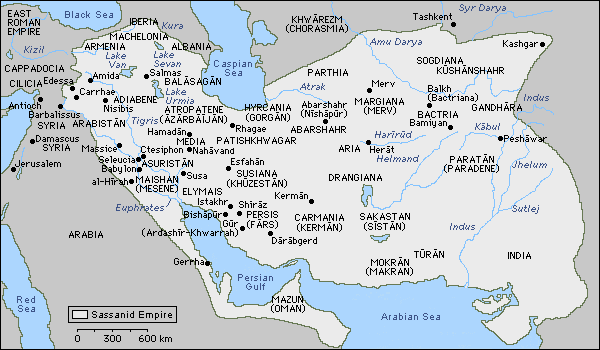
While reading this article, it may be useful to refer to this map of the Near East for the names of regions, cities, and the basic geographical lay out:

%alt
[1]


______________________________________________________________________


Perso-Roman Wars
Part II
1. Sassanids vs. Byzantines

The wars between Persia and Rome are the longest ever confrontations between two nations. From 92 BC to 627, each side sacked, massacred, conquered, and pillaged the other. This epic war would reach its climax not during the Perso-Roman wars, but during the Perso-Byzantine wars. Each side by this time had evolved and adapted. By the time the Sassanids and the Byzantines would meet in battle, their armies and strategies were relative copies of each other.

The Byzantines, and their Roman predecessors had by this time adopted the Persian heavy cavalry and the Sassanids had adopted Roman style siege warfare and standing army.

The Byzantine and Sassanid armies, in an effort to counter one another, actually became more and more the same with many interrelations.

Eventually, the wars would strain both sides to the extent that when the Arabs invaded, neither side were able to hold them back. The Persian Empire was overrun and the Byzantines were pushed back to Anatolia. In the end, it was neither the Persians nor the Byzantines that ended the 719 years of on and off war, but a third party.


2. The Perso (Under the Sassanids)-Roman Wars [217 to 395]
%alt
[2] Persian Empire ... and ... [3] Roman Empire

Where as the Romans were the main aggressors against the Parthians, the Sassanids showed their aggressiveness against the Romans and later the Byzantines. The Sassanids came to power with a heap of nationalism and pride. The first Shah of the Sassanid Dynasty, Ardashir, came to power promising to destroy the Hellenistic influence in Persia, avenge Darius II against the heirs of Alexander, and reconquer all the territories once held by the Achaemenid kings. He saw the Romans as Persia’s main enemy, and in the following wars that ensued, the Sassanids almost upheld the promises of Ardashir.

Ardashir began his reign by conquering the few lands left under Parthian control as well as invading Armenia. Ardashi blamed the Romans for aiding the Armenians, who were a close ally to Rome, and in 230 invaded Mesopotamia and besieged Nisibis, however unsuccessfully, while his cavalry threatened Cappadocia and Syria. The Romans were shocked when they heard the Persians had invaded. They still thought of the Sassanids to be no different than the Parthians, however, the Sassanids were much different in terms of aggressiveness and nationalistic zeal and the Romans would soon realize this. The Romans sent a delegation to ask for Persian withdrawal, noting the past defeats of the Parthians by the Romans as a warning. Ardashir rejected and in 231 Rome mobilized for war under Severus Alexander, drawing troops from Egypt to the Black sea to form three massive armies.

Rome's forces, under Emperor Alexander split up into three columns, one which went to Armenia (the left column), one which went to the Euphrates (the right column), and one that stayed in Mesopotamia, led by the emperor himself. Ardashir engaged the right column in battle, defeated it, and on this note, Alexander decided to end the war and retreated, although a peace treaty was never signed. In 233, after winning his wars in the east, Ardashir again invaded Rome, this time captured Nisibis and Carrhae. Ardashir extended the Persian Empire to Oxus in the north-east, to the Euphrates in the west, and on his death bed in 241, he passed on his crown to Shapur, who would carry on the war further into Rome.

%alt
[4] Emperor Valerian Conquered
Shapur was a great military man, however, he was more interested in philosophy and poetry, and reluctantly went to war. He invaded Syria, reached Antioch, was defeated in battle by the Romans under Gordian III, and made peace in 242. The Romans regained Nisibis and Carrhae and the border was once again the Euphrates. Angry at Armenia’s help to Rome, he invaded and put in place a dynasty friendly to Persia in 252 and later in 252, 254, 256, and 259 Shapur and Valerian fought several times with both success and defeat on both sides. Shapur, in 260, again invaded Rome, defeated and captured Valerian, gave the title Roman Emperor to Kyriades (another Roman, also knowns as Mariades, who would soon later be killed by Shapur after falling out of favor), sacked Antioch, and sent the thousands of prisoners back to Iran, where they were forced into labor. The remaining Roman troops retreated further into Asia minor, and the Persian army captured several more cities until finally Palmyra joined forces with the Roman general Callistus and forced Shapur to retreat and again the border was set at the Euphrates.

From 272 to 302, Shapur’s successors mainly kept the peace. However, in 283, Carus, a Roman general who had plans of invading Persia for many years, invaded. The Sassanid shah at the time, Vahram II, who was a weak ruler, was defeated in battle and Carus gained Seleuceia. He then crossed the Tigris and took Ctesiphon and was given the title "Parthicus Maximus" (the Romans still used that term to describe the Sassanids). Persia, dealing with internal strife, was not able to put up a strong resistance and Carus pushed eastward, but was later murdered by his Praetorian Prefect, Aper. After this, the Romans were pushed back, and the border was once again at the Euphrates. Yet again in 293, Narses, who succeeded Vahram II, invaded Syria but the Roman general Galerius was eventually able to recapture the lost areas along with Narses’ family. This was a devastating defeat for the Sassanids, which saw them give up land across the Tigris and Armenia.

%alt
[5] Shapur II ... and ... [6] Julian


In 309, Shapur II was born, and his reign would be the longest in Asiatic history, from 309 (crowned while he was still just a fetus in his mothers womb) to 379. It was during Shapur II reign that Rome and Armenia converted to Christianity, which comes into significance later in this epic battle of civilizations. Unlike Shapur, Shapur the II was trained in the arts of war, and in 337, he renewed the war with Rome, and continued it with short peaceful intervals in-between till his death. Shapur II fought a long line of Roman Emperors. In 363, Shapur II recaptured Armenia and Nisibis from Julian, was later driven back to Ctesiphon, and later forced peace on Jovian, who Shapur II had outmaneuvered, and gained the provinces on the Tigris and all of Armenia.

From the death of Shapur II until the reign of Khosru I, There was relative peace between the Romans (Byzantines) and the Sassanids due to the fact that both empires were facing threats from other tribes. However, the world was changing. The Roman Empire was split in two and later the Byzantine era would start in 395 (some say the Byzantine Empire began when the capital was moved from Rome to Byzantium in 330). During the first years of the empire the Byzantines were busy fighting to recapture the lost provinces of Rome and insure stability while the Sassanids were busy fighting in the eastern provinces and going through internal strife.


3. The Perso-Roman (Under the Byzantines) Wars [395 to 627]

%alt
[7] Persian Empire ... and ... [8] Byzantine Empire


Khosru I came to power in 531. In 532, he offered the Romans peace. Justinian accepted, wanting to have his eastern frontier secure before setting out to conquer Africa and Italy. On Justinians success, Khosru humorously asked for a share of the spoils on the grounds that Byzantium could not have won without peace on its eastern border. Justinian, sent Khosru costly gifts in return. In 539, Khosru declared war on Byzantium on the premise that Justinian had violated the peace treaty, however, it is more likely that Khosru wanted to take advantage of Byzantium having most of its troops stationed in the now conquered western provinces, instead of waiting for a strengthened Byzantium to invade Persia.

He invaded Syria, besieged Hierapolis, Apamea, and Aleppo until they paid him large ransoms. He then stood at the gates of Antioch. The Byzantines mocked Khosru, which angered him very much, and in consequence Khosru took the city by storm, burned down all the buildings except the cathedral, massacred part of the population, and sent the rest of the population to Persia. With delight, Khosru bathed in the Mediterranean Sea, which was once Persia’s western border. In the mean while, Justinian was using economic warfare against the Persians by aiding Ethiopian merchants who were trying to divert the Oriental trade rout from Persian ports to their own on the Red Sea.

In 541, Justinian sent for Belisarius to come to the rescue but Khosru had crossed the Euphartes with his spoils and Belisarius did not pursue him. Due to the fact that neither side could hold land across their borders for long periods of time, both the Byzantines and the Persians resorted to rapid attacks and then retreats. Khosru did this in three more invasions, during the Lazic War. The Lazic war, between the Persians and the Byzantines lasted from 542 to 562, over what is now Georgia, which was inconclusive and ended in a truce. In 545, Justinian paid Khosru 2000 pounds of gold for a five year truce and then another 2600 pounds for a five year extension. In 562, both Justinian and Khosru had pledged a fifty year truce, in which Byzantium would pay Persia 30,000 pieces of gold annually in return for Persia giving up its claims to disputed territories in the Caucasus and on the Black Sea.

Khosru, on the request of the Himyarites of southwest Arabia, sent an army to free them from the Abyssinians in 570. Justin II, the successor to Justinian, having had an alliance with the Abassinians, considered this an unfriendly act, and declared war in 572 with their Turk allies in the east. Khosru, despite his age, took to the field and captured the Byzantine frontier town of Dara while his general Adarman attacked the suburbs of Antioch and sacked the city of Apadmea. These defeats prompted Justin II to abdicate the throne, and Tiberius, the new emperor, made a three year peace. Byzantium, in these three years, organized a massive army, and on learning this, Khosru invaded in order to prevent a Byzantine attack. The two armies met at Melitene in 578, and Khosru suffered his first defeat due to his poor health and later died in 579 in Ctesiphon.

After Khosru’s death, Persia went through a series of successions which later installed the Byzantine backed Shah Khosru Parvez, who would later become a nightmare for the Byzantines. When The Byzantine Emperor Maurice, who had placed Parvez on the Persian throne and was a dear friend to Parvez, was murdered and replaced by Phocas as emperor, Parvez declared war on Byzantium in an attempt to get revenge on the usurper. The Sassanid armies took Dara, Amida, Edesa, Hierapolis, Aleppo, Apamea, Caesarea, Damascus, and all of the surrounding cities all within eight years (605-613). Now that Parvez was inflamed with success, he had the tolerance that had once flourished within the Persian Empire since Achaemenid times undone. He declared a holy war against the Christians.

Following his announcement, 26,000 Jews joined his army and in 614 Jerusalem fell to the Persians. Christians were massacred, their churches burned to the ground and the True Cross carried off to Persia. In 616 the Persians captured Alexandria and by 619 all of Egypt (to the border of Ethiopia) was once again under Persian rule. In the meanwhile, another Persian army overran Asia Minor in 617 and captured Chalcedon. The Persians held the city for ten years, and were only separated from Constantinople by the Bosporus. Parvez taxed the former Byzantine provinces into destitution (which would later leave nothing to stop the Arabs from overrunning both empires), and for the first time in many years, one side was able to hold the other’s territory.

%alt
[9] Heraclius
Parvez retired to his palace, and his triumph was hailed as the final triumph of Persia over Greece and Rome, of Ormuzd over Christ, revenge for the battles of Marathon, Salamis, Plataea, and Arbela, and Alexander answered. Nothing remained of the Byzantine Empire except for a few maritime Asiatic ports (from Tyre to Trebizond), some fragments of Italy, Sicily, Africa, the Balkan coast, Greece, a besieged capital, and its navy, which was still unbeaten. The defeat was so bad, that when Heraclius ascended the throne he proclaimed to move the capital to Carthage, where it would be safe, but was stopped by the Patriarch of Constantinople. Ironically, in the end Parvez’s favorite wife, and the one with the most influence, was Christian, and once again Parvez, under influence of his wife, allowed tolerance of Christianity in Persia.
However, Byzantium was not yet completely defeated. After ten years, Heraclius, the successor to Phocas, who ruled from 610 to 641, was able to build a new army. In 624 he sailed through the black sea, landed in Armenian, and invaded Persia from the rear, which started what is known as the Byzantine Crusade, while his Turk allies attacked Persia through modern day Georgia. Persia, having its forces scattered from Anatolia to Egypt, was not prepared for such an attack, which proved decisive in Heraclius‘s campaign.


As Khosru had desecrated Jerusalem, Heraclius now destroyed Clorumia, the birthplace of Zoroaster and put out its sacred light. Heraclius defeated Khosru’s army in Armenia, while his brother Theodorus defeated a second army to the west. In the mean time, the Persians and their Avar allies laid siege to Constantinople in 626, which failed. The last battle between the Byzantines and Persians was the battle of Nineveh, in 627, which ended in a Persian defeat. Parvez fled to Ctesiphon, where he was later killed by one of his sons, Kavadh II, who later made peace with Heraclius by returning all the lands that Persia had taken from Byzantium along with the True Cross.

This would be the last time the Byzantines and Persians would war with each other. After so many years of war, two crusades, and countless casualties, neither side gained anything. The borders went back as they were in the Roman and Parthian times, both sides were weakened, and neither had the power to defend when the time presented itself. Heraclius was so happy with his victory that he did not observe that on the very day he placed the True Cross in its shrine, that the Arabs had attacked a Byzantine outpost. The impoverished Byzantine provinces could not defend themselves, and were overrun quickly. The weak Persian kings that followed could not stop the Arab invasions, and Persia was overrun.


4. Conclusion
One major lesson can be taken from this great war in the course of human history. That lesson is that war and conquest will never bring happiness in the end, revenge will never accomplish its goal, and that humans tend to repeat history over and over, even when knowing the consequences. What started with the Greeks and the Achaemenids was carried on to the Romans and the Parthians, climaxed with the Byzantines and the Sassanids, and ended with the Arab invasions. History, is not only one long story, it is one vast lesson.


5. Bibliographies and Sources


http://en.wikipedia.org/wiki/Lazic_War

http://en.wikipedia.org/wiki/Roman-Persian_Wars

Durant, Will. The Story of Civilization: The Age of Faith. New York: Simon and Schuster, 1950. Pages 142-151.


"Byzantine Empire." World Book. 2005 ed.

Judd, Gerrit P. A History of Civilization. London: Collier-Macmillan Limited, 1966. Pages 102-103.

The Cambridge Ancient History: XII. The Imperial Crisis and Recovery. Cambridge: At the University Press, 1965. Pages 321- 322, Pages 126- 127 and Pages 336- 338
The Decline and Fall of the Roman Empire: Volume Two. New York: The Heritage Press, 1946. Pages 1510- 1552.


6. Maps and Pictures


Cyrus the Great - All Empires

Cyrus the Great - All Empires


Cyrus the Great

By Darius of Parsa, 31 October 2007; Revised
Contents »
Introduction

The ancient Middle East was home to one of the greatest and strongest warring factions in all of history. The sands were stained red with blood of all who have died in her deserts. The sixty years before 500 B.C experienced some of the most well known rebellions in history, where fathers fought fathers, and where brothers fought brothers. The rebellion of Persia in 550 B.C led by Cyrus II (later called Cyrus the Great) conquered much of the known world. The king created an empire that stretched from the border deserts of Egypt to the mountains of Asia Minor, all the way to the lush rainforests of India. In total, the new empire covered two million square miles and was the largest nation up to it’s time. Cyrus the Great was called a man of peace, a man of human rights, and a man that carved one of the greatest empires in history, The Achaemenid Persian Empire. Before Persia’s reign as the ultimate and supreme superpower, there were four nations which covered Asia (Middle East). These nations were Egypt, Lydia, Babylon, and Media. At this time Persia was a tributary state to the Median Empire and had an occupation. According to Herodotus there were six peoples that were the Medes. Herodotus says the tribes were the Magi, Budii, Arizanti, the Struchetes, Paretaceni, and the Busae. All of these tribes migrated from the west, when the kingdoms of Mesopotamia were in complete glory. The peoples migrated with what they could take, some men brought horses and other pack animals on their journey to lighten the load, and improve the speed of travel. This type of traveling was much alike the colonization of the western frontier of the early United States in the 1800’s A.D. The peoples, whom crossed the Zargos, neglected the use of writing, mathematics, and other skills useful for life in large towns, years earlier. The men and women, who crossed the mountains, didn’t eat or drink for days at a time, filling up their provisions whenever they came to an oasis. The tribes united due to the constant barbarian raids from the north and the threat of an Assyrian invasion from the west. These people east of the Zargos came to be known as Aryans by the neighboring empires. The Aryans soon adopted the religion taught by Zarathrustra, a prophet born between the years of 1000 to 660 B.C. He sometimes called a Mede, other times a Persian, sometimes a Bactrian, and sometimes as a divine being. Nevertheless, Zarathrustra promised that if someone was to worship Ahura Mazda (the Wise Lord), then that person was given a life of prosperity. “It is where one of the faithful makes a home with cattle, wife and children, and where the cattle thrive and the dog, the wife, the child, the fire are thriving . . . where the faithful one cultivates corn, grass, and fruit in good measure; where he irrigates dry ground and drains the ground that is too wet . . . the gift of a pair of fowls to the faithful is as a gift of a house with a hundred columns” were such promises of a devoted Zoroastrian.

During the years when Persia was under Median rule, the Persian’s task was to defend the six Median tribes from southern raids from apposing tribes and empires. If Persia was unsuccessful at defending the region, the Medes had enough time to react to the situation and send military aid. The Persians became restless and furious. Just the thought of being a supplement to the Medes made the Persians outraged and offended. For over three hundred years they executed function and now it was time to start their own kingdom and their own superpower, all done under their king, Cyrus II.
A Controversial Birth

There are a number of tales of Cyrus’ birth and his childhood. According to Herodotus’ version, Astyages, king of the Median nation, appointed his daughter and Cambyses, a royal Persian, to marry. The couple gave birth to a son by the name of Cyrus. Herodotus wrote an excerpt that states that Astyages had a dream that their son would testify against him, Astyages ordered Cyrus to be killed. Harpagus, a trusted general of Astyages was to carry out the deed. The general did not kill Cyrus, but got rid of him by giving Cyrus to a farmer’s family. Astyages discovered Harpagus’ treason doing and Astyages ordered his son to be killed. He was tricked into eating his own son’s meat that had been mixed in with his dinner. The Median lord also ordered an interpretation of his dream, which was very common during his time. Astyages’ board told him that his dream was indeed false and Cyrus did not appose any threat to himself or his empire.
Formation of an Empire

The months before 550 B.C, were months of propaganda for Persia. People across the Persian state spread the word of a new age, a new life, and a new empire. Cyrus’ asked for people to congregate at one location, most likely by a hill, or a high promontory. Hundreds of ready Persians stood before him and listened. Cyrus spoke loud and clear above all else about freedom, liberty, and justice. He boosted the Persians moral, they needed it, they were about to march north to Media, one of the most powerful empires in the history of the world. After the speech, there was total silence, they knew what they had to do, and it was time for the Persians to go to war. In the morning, the Persian forces grabbed their spears, checked their bowstrings, and readied their horses. The Mada were doing the same. The Persians walked for miles to the north. The Mada went south. The Persians confronted the Medians. The Medians confronted the Persians. To a Persian solider the sight must have been heart-stirring. In front of the Persian stood the Median army, their weapons glistening in the mid-day sun, and they were numerous across the scrub landscape. The Medians were better trained than the Persians, they had to be to protect their empire, the Persians on the other hand were weaker compared to the Medians in ways of training and weaponry.

The forces engaged, one side fighting for a new empire, and another fighting to save an old one. The clanging of the blades, the yelling of the combatants and the shouts of their commanders must have been deafening. Hours into the battle the victor was clear, and out of the dust came a new empire, the Achaemenid Persian Empire. According to Greek accounts, the famous city of Pasargadae was built at the same location were the battle had been fought. Persia was in complete control of Media by 549 B.C, after the capture of Ecbatana, the capital of the Median nation. There were no battles after that between the Persians and Medians, besides small skirmishes around lightly controlled areas of the Persian occupied Media.

Cyrus claimed total control over Media in 546 B.C and accepted his crown and title of King of Persia. Croesus of Lydia, Nobonidus of Babylon and Amasis II of Egypt couldn’t believe what they have witnessed, a total collapse of the Median empire. Xenophon, a Greek historian, wrote about Cyrus, “He was able to extend the fear of himself over so great a part of the world that he astonished all.” The leaders became furious with Cyrus of Persia and created treaties with themselves to unite against Cyrus and his new empire. Alliances against empires have been a solid part in ancient history. About one hundred years before Cyrus’ campaign, the Assyrian Empire ravaged the surrounding empires with their professional and well trained armies. The Assyrian army was made up of outstanding spear infantry, the new edition of cavalry, and devastating chariots. The Assyrians were also some of the first peoples to employ siege equipment. The Assyrian engineers were capable of building siege shelters, battering rams, large ladders for scaling walls, and sophisticated ramps. They also hired miners to dig under the enemy’s walls, uttering them obsolete. The armies of Assur crushed any peoples that resisted their rule, but before the Assyrians declared war they often tried to scare their opponents into surrendering. The reputation of an Assyrian soldier was alarming; they were very well trained, brutal, and ruthless. This was a combination every empire feared, no matter how large or powerful. After conquering a town, the Assyrians gathered countless numbers of commoners and preformed acts of torture. The Babylonians and Medians allied to destroy the Assyrian Empire. By 626 B.C, Assyria was crippled after loosing a battle against Babylon about three hundred kilometers away from the city of Babylon in Mesopotamia. In the year of 612 B.C, the Median King Cyaxares crushed Nineveh, and the Assyrian Empire was defaced from the world. Lydia, Babylon, and Egypt all thought that if the alliance against the Assyrians worked, then the Persians should be no problem at all.

Cyrus and his fellow Persians soaked in the advantages Media had to offer. Media had better horse pastures, a way to attack Babylon and Lydia, and men ripe for military involvement. One of these men that were ripe for military action was a Median general Harpagus became one of Cyrus’ subjects. Texts say that Harpagus was in charge of the Median army against Cyrus, but quickly changed sides. Regardless, Harpagus helped Cyrus in many battles as either a trusted general or an advisor.
War against Lydia

Croesus of Lydia became impatient, and he found Cyrus’ conquests insulting and undeserved. Croesus ordered his Lydian army to attack the Persians at the town of Pteria in the Cappadocia mountains. Cyrus expected this, an attack by the enraged superpowers of the ancient world. The Achaemenid king was not just a man of war, tactics, and empire; he was also a man of diplomacy. Cyrus asked the Greek Ionian city states to send military assistance. Ionia did not think the idea was intelligent to attack their overlord. If the Persian-Ionian army were to witness defeat, the Lydia would of surly punished Ionia for treason and revolting against Croesus. The Ionians kept their infantry-based army within their walls and kept their clean record. Cyrus called on his Persian and Median warriors to rescue the citizens of Pteria. The Persian lord collected his forces of horsemen, bowmen, and infantry units and sent them to Pteria, and the outer edges of his empire. The battle of Pteria was a harsh and cruel one. The amounts of casualties on both sides were heavy, and the injuries were numerous. There was no victor from the fields beyond Pteria, in the end Croesus, still undefeated, retreated back to his capital of Sardes. The Persians recaptured the fort by dawn. No doubt Croesus took slaves along with him back to Anatolia, and used them to complete difficult tasks throughout the empire. Slavery was very common throughout the ancient world. When an empire took over another, slaves were often transported back to the subjugator’s homeland, often the capital. One example is the completion of the pyramids, completed by the work of thousands of slaves, the Athenian architecture, and the enslaved Jews sent to Babylon after Nebuchadnezzar conquered Jerusalem. After the battle Cyrus sent diplomats to Croesus, asking him to give up his title as king of Lydia, and recognize the Persian lord as the supreme leader. Cyrus also promised that Croesus would still be given the right to lead his own people of Lydia, under Persian supervision. Persia always tried to talk to her enemies before engaging in battle, there would be no reason to waste men and resources to fight a neighbor, if they could rather entice the enemy to surrender. The Lydian king did not accept the proposal, and that left one alternative, total war.

After the Battle of Pteria, the Lydians returned home to fight another day. Crosesus could not comprehend what just happened; he always achieved victory, in every battle he had fought. The previous battle was different; Cyrus, a leader who years before had little experience dealing with military matters, had almost achieved victory against the battle ridden leader of Lydia. Croesus sent ambassadors to his allies, asking for their armies to help reinforce his, and fight Cyrus before another battle arose. Persian spies overheard what Croesus was planning, and before the allied force was united, Cyrus ordered the invasion of Lydia, at her capital Sardis. The Persians had two choices, to travel the snow ridden mountains of Cappadocia, or march across the plains of Northern Babylonia, to arrive at their destination, Sardis. Cyrus decided that taking the mountain route was too dangerous, considering that it was the winter season. The leader chose to travel over the plains instead, the chance of a Babylonian flanking maneuver was relatively low, as the Babylonians did not have enough time to muster her forces and lead an attack. The battle came to be known as the Battle of Thymbra, one of the most decisive battles in all of history. Harpagus, Cyrus’ trusted general suggested using dromedaries before the battle, instead of using horses. Cyrus accepted the idea, and ordered his men to dismount, and use the pack animals as animals of war. The tactic worked, the Lydian cavalry was frightened by the smell of the camels, and disengaged from the battle field. The Lydian army of 100,000 was defeated by an army of only 30,000, less than one-third its size. The Persians annexed another empire, Lydia in 546 B.C. Along with Lydia; the Greek colonies of Ionia were also under Persian occupation. The conquered Ionians referred to Cyrus as a strong and righteous ruler, which was very uncommon in the ancient world for a conquered nation to say good about their new overlord. Croesus was exiled to Media that same year.

In the battles against Lydia, Cyrus observed Lydian tactics and incorporated them in his own army, willing Lydian men into his military and Lydian customs into his empire. Cyrus let the leaders of defeated empires to remain leaders, and govern their own portions in the Persian Empire, much like Alexander the Great of Macedonia centuries later. This fact holds true with Achaemenid history from its rise in 559 B.C to its fall in 323 B.C. The Persian Empire existed on the countries it conquered, the ideas of many, and the peoples of numerous nations. Cyrus even familiarized himself with Assyrian strategies and used them in his battles against the nations that testified against him.
Attention turns to Babylon
Cyrus turned his sword to the Neo-Babylonian Empire, which held the fertile lands of Mesopotamia and many surrounding lands. Early peoples of the ancient world called the area between the Tigris and Euphrates “The Land.” The dwellers often created tales and stories about this area of the world. The Land was well known to the dwellers as a land of mystery, where creatures arose from the water and spoke with men. One of these creatures was Oannes, who seems to be part-man, part-fish, who rose up from the water and taught the river peoples how to farm, write, create laws, sculpt, and how to bring about scientific achievements. The tribes, over time, created nations, borders, and sets of governments. The Ur dynasty was feasibly the most powerful of them all. The clans were united and therefore could take up arms against intruders, instead of attacking each other. These wars are much alike the battles between Greek city states, where different ideas about how the world should be run, and who should rule over the common territories clashed. The differences often lead to war. In the kingdom of Ur, this type of bloodshed was not present, making the empire capable of other military interests. With such long periods of relative peace, the empire could also focus on the arts and city management. Unlike the earlier Ur dynasty, the Neo-Babylonian Empire was under a weak and feeble ruler, named Nabonidus. Cyrus took advantage of his enemy’s burden, much like he did when he attacked Croesus, years before. The Persian King’s intent was to march into southern Babylonia and take the capital of Babylon itself without much dispute, but his army was confronted by a Babylonian army near the town of Opis. Although Cyrus was victorious, the battle was a close one, neither side inflicting significant damage on the other. The Persians took over the city, and in turn caused a nearby city, Sippar to fly the white flag. Nabonidus ordered a large division of troops to patrol the Euphrates River in order to control law and order in his slowly dieing empire, and to protect the empire from an anticipated Persian attack. Nabonidus hoped that the natural defense would give his army the upper edge when another wave of troops descended on them. This tactic had been used by innumerable Babylonian kings before him, with great success, but in the year of 539 B.C, the strategy rendered fruitless. The Persians did not confront the Babylonians on there terms, and marched down the Tigris instead. The Achaemenid army reached the walls of Babylon shortly after giving the destination. According to Herodotus, the Persians won a battle not far away from Babylon itself, and that the remaining Babylonian army retreated to the walls of their city. Herodotus also writes that Cyrus did not attack Babylon directly, but derived canals on the Euphrates. The river then was drained to a height “to the height of the middle of a man’s thigh”. The Persian army then walked under the walls of Babylon itself.

When the Babylonians woke from they’re slumber, they found themselves under Persian rule. Cyrus freed all the Israelite slaves, and let them return to Israel if they wished. The Achaemenid King did not punish the Babylonians, but confronted a temple prayed to the god of Marduk. Cyrus confined Nabonidus and announced himself as “king of Babylon, king of Sumer and Akkad”. In the years between 549 B.C until his death, Cyrus the Great was constantly subjugating and conquering tribes and nations on the fringes of his empire onward. The Persian king conquered Bactria, modern day Afghanistan, all the way to the Jaxartes river. Cyrus carved his name into stone in the city of Cyropolis, marking one of his longest journeys in his military career. From one end of his empire to the other, was over three thousand miles, every nation conquered in less than twenty years. Even the Assyrian Empire, hadn’t of come close of achieving such miraculous feats.
Death and Legacy
Cyrus himself died in battle in the August of 529 B.C against the Massagetae, a tribe on the northeast fringes of the empire. Croesus of Lydia himself warned Cyrus not to attack the Massagetae, but Cyrus ignored him and pressed his attack anyways. Before his death, Cyrus ordered that his army abandon their camp, making a fake retreat. Queen Tomyris, the leader of the Massagetae, found the facilities completely empty. Her army rejoiced at their victory, and drank the alcoholic wine within the tents. The Persians attacked the Massagatae during their celebration. The Massagatae, having dropped some of their equipment panicked and rushed to draw their weapons. The Persians won a great and cunning victory, but the Queen was still alive and still capable of commanding the remainder of her army. Another set of Massagatae warriors met up with the Persians and slaughtered them. The Persians not only suffered heavy losses, but a capable leader, Cyrus the Great. Sometime in the battle Cyrus was struck with an enemy arrow, Cyrus fought on thereafter, but the pain got to him, and died on the battlefield. Queen Tomyris requested the body of Cyrus, when it was brought to her; she chopped the head off the torso, and dipped the head in blood. This was to show her power as the supreme leader of the ancient world. Cyrus the Great’s memorial told on what he had done during his lifetime. The beginning line wrote “I am Cyrus, King of Kings.” Most citizens of the Achaemenid Empire agreed, Cyrus the Great was indeed one of the greatest kings ever to walk on Earth.

The Achaemenid Empire: Government and Institutions - All Empires

The Achaemenid Empire: Government and Institutions - All Empires

The Achaemenid Empire: Government and Institutions

By Constantine XI, August 2006; Revised
The arrival of the gigantic personality of Cyrus the Great of Persia was one of the most dramatic events of the ancient era. Beginning in the mid sixth century BCE, the ambition and energy of this imperial minded individual saw the conquest of a number of states across west Asia. Never before in the history of west Asia or the adjacent regions had conquest occurred on such a grand scale. The sheer speed and breadth of the conquest was unprecedented and had come from a seemingly minor power: the Persians.
In spite of the death of Cyrus, the newly established empire continued to expand further. By the reign of Xerxes I, she had achieved her greatest territorial extent, incorporating the lands of three continents and more than 47 empires, kingdoms and nations into her body politic (Farazmand, 2002, p. 294). This empire, with its unprecedented size and multifaceted composition of peoples, could have been expected to have collapsed in the absence of her heroically portrayed founders. Yet, she survived largely intact and continued to play a politically dominant role for two centuries, until her sudden conquest by Alexander of Macedon.
Aside from military organisation and capable leadership, the Achaemenid Empire relied on an extensive government structure, bureaucracy and interplays of power to sustain itself. This paper shall address how the Achaemenid government and administration were structured, the nature of power relations and the roles these played in the survival and functioning of the Achaemenid state.
The natural anchor for any sort of administrative activity in the empire was royal authority. The Achaemenid empire had been conquered under the leadership and resources of the Persian monarch, so it was from there that ultimate power emanated. Direct royal administration over the pettier satrapal affairs across such a vast empire was impossible, yet a clear relationship existed between the crown and the Persian satraps. Xenophon records Cyrus’ command in setting up some early satraps, “We must choose for the satraps who are to go abroad persons who will not forget to send us anything of value in their districts, so that we at home may share in all the wealth of the world. For if danger comes, it is we who must ward it off” (Cyropaedia, VI 5). The relationship is clear, economic tribute is to be paid to royal authority, while royal authority shoulders the burden of military responsibilities. Herodotus gives a clear list of how much annual tribute was exacted from each of the 20 Achaemenid provinces (Herodotus, III 90-97), while further evidence of the Achaemenid promise of overarching military protection can be gleaned from the fact that the city of Mylasa, in Asia Minor, remained unwalled. Only by alluding to the possibility of attack on the unwalled city by the Persians themselves was the local ruler, Mausolos, able to convince the citizens to contribute to the Persian tribute money (Meadows, 2005, p.184). Only with a reliable guarantee of overarching protection from a higher power would a substantial city neglect the building of defences against external attack.
Royal authority also regulated the foreign relations of the empire. At the ends of the vast empire lay a range of peoples who were not incorporated into the bureaucratic control of the Persian state. The official relations with these peoples was the special prerogative of the Great King, though, in some instances, vassal kings in areas such as western Anatolia were given some autonomy in dealing with small states (Allen, 2005, p. 47). The Achaemenid ruler resorted to a number of ways to regulate the foreign relations of the empire. Without actually occupying territory, the Persian Great King could expect gifts from frontier states to be sent to him personally in recognition of his superiority. This was the case early on with the outlying states of Samos and Cyrene (Allen, 2005, p. 46). The transport of gifts to the royal capitals instead of to the courts of local satraps underlines the primacy of the Great King in foreign relations dealings. Recognition of friendship was another diplomatic ceremony which could take place, as the foreign state made an offering of earth and water to the Great King. In such a way the Athenians made the offering to the Persians, to later incur the wrath of the Great King when they sent ships to aid the Ionian revolt in the early 5th century BC (Herodotus, V 66-78).
The royal court, itself, served as a manifestation of the Great King’s power and was a foreign relations instrument, as well as serving propaganda purposes for visitors in the more distant satrapies. Girshman (1964, p. 156-209) provides a description of the manner in which foreign dignitaries were received by the Great King at the Apadana of Persepolis. The foreigners would pass through the gatehouse, complete with plaques in gold and silver, proclaiming the supreme power and strength of the Great King. After this, an ordered procession would pass before the Great King, who watched from a royal box. The walls throughout the Apadana were decorated with scenes of the Great King portrayed in manifestation of imperial power, receiving tribute or carrying out martial acts. After meandering through a complex series of halls, the dignitaries might, finally, be allowed into the opulent throne room in which the Great King would receive them. The whole intricate process of court protocol was a clear manifestation of imperial propaganda, as useful on foreign visitors as it was on Achaemenid subjects and tributaries.
The Persian aristocracy was incorporated into government machinery to perform roles and duties. During the formative early years of the empire, the Persian aristocracy needed to be carefully managed to prevent it from compromising the cohesive relationship between royal power and that of the satrapal authorities. The accession of Darius I (522-486) saw the true power of the aristocracy in challenging royal authority. Darius, himself, overthrew the pretender Bardiya by venturing into the palace with a band of nobles to kill him (Allen, 2005, p. 41). The succession of Darius saw widespread revolts across the empire, which had to be crushed violently. Such a trend suggests that many aristocrats considered themselves as legitimate as Darius, in becoming Great King, an attitude which could later result in extensive civil disturbance and warfare at the time of succession. To counter this, Darius built up the cult of personality attached to the Great King, as well as expounding the achievements of Cyrus, of whom Darius asserted he was the legitimate heir. Sources indicate the acceptance of a “founding legend” was widespread amongst the populace regarding Cyrus (Frye, 1963, p.42). This cult of personality, on the one hand, helped to defuse aristocratic designs on the throne. On the other, Persian court protocol helped establish a personal relationship between each individual aristocrat and the monarch. The dynastic principle was something the Persian nobility could identify with, while Briant (2002, p. 352) claims other measures helped ensure aristocratic loyalty, “by instituting a system of ‘gifts with string attached’, court hierarchy, and education based on monarchic values, the Great Kings succeeded in integrating the aristocratic circles into the fabric of royal government and the court”. In such a way, the Great Kings were able to rely upon a relatively loyal aristocracy to perform important official functions for them in governing the empire. One such instance is the career of a Pharnaka, who was appointed to the satrapy of Hellespontine Phrygia after a long period of official service in the Persian court at Parsa. This individual, following the dynastic principle set down by the royal family, fathered a whole succession of satraps for that particular satrapy, administering it on behalf of the Great King (Briant, 2002, p. 353).
With the nature of royal and aristocratic roles in the Achaemenid Empire defined, the actual administrative structures themselves may be examined. The empire was divided into smaller units known as satrapies, most of which were governed by a satrap who was directly responsible to the Great King (Meadows, 2005, p. 183). The word ‘satrap’ in Old Persian means “protector of the realm” (Briant, 2002, p. 65), the Achaemenid equivalent of a governor. The satrap was the Great King’s personal representative in the satrapy and was directly responsible to the monarch, whose favour the satrap was required to obtain. Although there occurred the inheritance of satrapal power within families, such as the previously mentioned Parnaka, each potential satrap would be appointed only with the approval of the Great King and would only continue in their role with his continued consent (Herodotus, VI 43; Briant, 2002, p. 337). The need for practicable local administration was always one which the Achaemenids saw had to be combined with direct subordination and accountability to the Great King.
There were some exceptions to the appointment of a satrap. In some instances, the Great King allowed a local ruler to perform the functions of a satrap and govern the region on the Great King’s behalf. In such a way, Xenophon (Cyropaedia, VII 4.2.) notes how local princes retained their power in Cilicia and Cyprus, the Achaemenids never sending a satrap there to govern. This demonstrates the willingness of the Achaemenids to allow flexibility in certain contexts, they did not insist on a rigid standardisation and total centralisation of administrative processes. Such policy reflects the Achaemenid understanding that they were administering an empire of vastly differing civilisations and peoples.
The satrap was delegated a number of set responsibilities to do with the administration of his satrapy. These were, essentially, civil roles, such as paying for the maintenance of military forces, remitting an annual tribute to the Great King, and administering justice and disputes in the satrapy (Briant, 2002, p. 341). In short, the satrap’s role was one of wide ranging civil powers for his particular territory, with particular emphasis being place on the sending of tribute to the Great King. Thucydides takes note (VIII 5) of how the failure by satrap, Tissaphernes, to pay tribute on time saw him issued a warning by the Great King. In such a way, the relationship between satrap and King is, again, evident in the shouldering of military power and responsibilities by royal authority and the channelling of tribute to the heart of the empire by the satrapal authorities.
A clear demarcation between military and civil responsibility applied to satraps. Early problems with ambitious satraps, such as Oroestes during the reign of Darius I, highlighted how a governor with both civil and military authority posed a threat to the Great King (Briant, 2002, p. 65). While Oroestes, himself, was dealt with simply enough by an order from Darius demanding his execution, to further safeguard their interests, the Great Kings ensured that actual command of military forces was to pass to a commander independent of the satrap. From Darius I onwards, such a man was directly responsible to the Great King personally, who decided his mission and span of authority (Dandamayev, 1999, p. 47)
Tribute to the Great King, a key responsibility of the satraps, was arranged through an assessment of the economic productivity of the territory in question. Darius I, initiator of so much of the Persian administrative system, established the standard for tributary payment by assessing each satrapy based on the mean annual yield in agricultural produce (Dandamayev, 1999, p. 53). As already mentioned by Herodotus (III 90-97), a fixed annual tribute paid in silver or sometimes in kind was then set. The tribute which flowed into the royal capitals served as a private reserve of the Great King. The various royal capitals collected tribute, which could then be allocated to the local administrative projects of the region. The treasury could be used in emergencies, such as during a severe famine in Parsa during 467/6, in which the enormous Persepolis treasury was used to contribute to famine relief (Cahill, 1985, p. 386). In such a way the Persians were able to collect income used for local administration, while enriching cities like Persepolis to augment the Great King’s prestige through overt displays of opulence (Girshman, 1964, pp. 265-78). Such a system of tribute indicates an advanced ability for wealth collection and disposal by contemporary standards.
The collection of tribute in the smaller capitals of the empire provides an indication of Achaemenid willingness to incorporate foreign practices into their administrative apparatus, while also making use of pre-existing bureaucratic structures to achieve governance. As already noted (Briant, 2002, p. 64), the Achaemenids were willing to leave faithful local princes in charge of administrative affairs in certain provinces. In the administration and receipt of taxes at the Jerusalem temple, the Achaemenids took over crucial aspects of a pre-existing Neo Babylonian fiscal practice known as the “king’s chest”, a fiscal administrative council established for the Jerusalem temple under Babylonian king Nabonidus (Schaper, 1995, p. 534). The Persians adopted the “king’s chest” system wholesale, making the addition of certain of their own officials to scrutinise the receipt of funds. Not only were the Persians willing to make use of pre-existing administrative structures, they also realised the value in utilising pre-existing officials and social classes to assist in administration. The cooperation between royal officials and Hebrew temple elders in administering the revenues paid to the Jerusalem temple exemplifies this: “the collaboration between the central authorities (Persians) and temple hierarchy seems to have been smooth and efficient; the needs of both partners were duly catered for” (Schaper, 1995, p. 537). These incidents of collaboration and inclusion by the Persian authorities illustrate the Achaemenid understanding of the benefits of incorporating limited foreign administrative practices into their framework of governance.
To further strengthen the effectiveness of Achaemenid bureaucracy, a system of checks were put in place to ensure satrapal duties were correctly discharged. Satraps and military commanders had recourse to complain about one another when they considered the other to be improperly discharging their duties (Briant, 2002, p. 341). Even more powerful in monitoring and assessing the actions of the straps was the institution of the Great King sending officials personally responsible to him who would scrutinise the conduct and effectiveness of the satraps. Farazmand (2002, pp. 309-310) identifies three officials, a state legal attorney or “ears of the king”, a state inspector general or “eyes of the king” and an especially powerful royal secretary. That these individuals were employed by the king were a clear indication of Achaemenid efforts to create a system of checks and balances to ensure an effective and accountable bureaucratic machine. Another key example of the reach of the Great King over his officials lies in the maintenance of the so called Royal Roads. The Great Kings used these as a means of expedient delivery of messages for courier service and also for military purposes. Through such a means, a journey from Susa to Sardis,typically estimated at 3 months of travel, could be done in barely a week using the relay station established by the Achaemenids (Allen, 2005, p. 118). Achaemenid rulers clearly understood the need to maintain communication and surveillance across the breadth of their dominions, ensuring the loyalty and compliance of distant satrapies.
The Achaemenid Empire was unprecedented in its location and time period in history for its sheer size, multiculturalism, power and reputation. Such a nation, a pioneer in the art of hegemonic domination, was faced with a range of challenges and demands on its power in governing such extensive territories.
At the centre of the Achaemenid power structure lay royal authority, the ultimate source of law, foreign policy relations, imperial splendour and propaganda and the main source of the empire’s military might. The Persian Great King and his court were the ultimate manifestations of the empire’s power, having ultimate and superior authority over the administrative apparatus of state. Royal authority augmented its power by providing an inclusive role for the aristocracy, incorporating them into civil and military roles through individual ties to the Great King.
The Achaemenid administrative structure was designed to provide a local system of direct administration in most satrapies, with the provision of regular tribute by satraps being reciprocated by royal military might. The satraps themselves had clearly defined responsibilities, including a division of civil and military responsibilities, which were subject to checks and balances. The Achaemenid administrative structure proved itself adaptable and inclusive on occasion, able to accommodate the realities of a multifaceted empire. The result was an administrative achievement which proved largely durable over two centuries, until Achaemenid power was extinguished by Alexander of Macedon. Adaptable, detailed, centralised with some localised adaptations, the Achaemenid structure of government and administration proved an impressive response to the challenge of running an empire of unprecedented size and complexity.
Bibliography:
Primary Sources:
  1. Herodotus, The Histories, translated Aubrey De Selincourt, Penguin Books, London, 2003
  2. Thucydides, The History of the Peloponnesian War, translated Richard Crawley, available at http://www.gutenberg.org/dirs/etext04/plpwr10.txt, accessed 16/05/2006
  3. Xenophon, Cyropaedia, translated Henry Graham Dakyns, available at http://www.gutenberg.org/dirs/etext00/cyrus10.txt, accessed 16/05/2006
Secondary Sources:
  1. Allen L., 2005, The Persian Empire: a history, British Museum Press, London
  2. Briant P., 2002, From Cyrus to Alexander: a history of the Persian Empire, tranlated Peter T. Daniels, Eisenbrauns, Winona Lake
  3. Cahill, 1985, The Treasury at Persepolis: Gift-Giving at the City of the Persians, American Journal of Archaeology > Vol. 89, No. 3, pp. 373-389
  4. Dandamayev M., 1999, Media and Achaemenid Iran, in History of civilizations of Central Asia volume II, Motalil Banarsidass, pp. 35-65
  5. Farazmand A., 2003, Administrative Legacies of the Persian World-State Empire, Public Administration Quarterly, Vol. 26 Issue 3/4, pp. 16-316.
  6. Frye R.N., 1963, The charisma of kingship in Ancient Iran, Iranica Antiqua, Vol. 4, pp. 36-54
  7. Girshman R., 1964, Persia: from the origins to Alexander the Great, translated Stuart Gilbert, Thames and Hudson, London
  8. Meadows A.R., 2003, The Administration of the Achaemenid Empire,in Curtis J. & Tallis N., The forgotten empire the world of ancient Persia, British Museum Press, London, 2005
  9. Schaper J., 1995, The Jerusalem Temple as an Instrucment of Achaemenid Fiscal Administration, Vetus Testamentum > Vol. 45, Fasc. 4 Oct, pp. 528-539

Chinese Art and Poetry: Chinese Poems with English Translation

Chinese Art and Poetry: Chinese Poems with English Translation


* * *

Ps:9:11:
11 ¶ (9-12) Sing ye to the Lord, who dwelleth in Sion: declare his ways among the peoples.

______________________________________________

To what can our life on earth be likened?
To a flock of geese,
alighting on the snow.
Sometimes leaving a trace of their passage.

Su Shi (Su Dongpo)
______________________________________________

The Way of Heaven is to benefit others and not to injure. The Way of the sage is to act but not to compete.
- Lao Tzu


I have often wondered when will China join the rest of the world. What I mean is this. In the Five Emperors and Three Kings period, not the mythological version but, twenty two centuries ago, the Chinese set a standard for themselves. That standard was that they would, to the exclusion of all foreign interference, remain Chinese no matter what. It is very important to note that with the exception of the very short Legalist school period for about 22 years at the beginning of real Chinese history then, Chinese culture has always been eclectic and syncretic. The Legalist school remained gone and forgotten until Mao under the training and influence of his Russian Communist Jew Bolshevik masters revived a super version of the anti-intellectualism and rigourous anti-religious and totalitarianist rule of the Legalists under his Chinese Communism with the most extreme version under aegis of the Red Guard in 1965-1968. That insured that any rapprochement with the West would be destroyed for a long time. Nixon, whatever else he was and did, had one thing correct, it was necessary for any kind of governing of the world that would preclude all out conflict, for China to be opened to the world. He attempted that at least.

Historically a typical Chinese anomaly in the midst of world events, is the Confucian bureaucratic victory over the relatively brief incursion of the Chinese to compete with Arab slave traders on the East coast of Africa, which resulted in Chin Ho’s fleet being ordered by the Emperor home to China and dismantled and the African continent left at that time, the mid 15th century, to the savage mercies of tribalist Arab slave traders and Portuguese and Spanish European slavers followed by the rest of the Europeans. For the record, Chin Ho’s fleet far out gunned anything any European or any other Navy would put to sea for a long time. Had things gone differently, I might be writing this in Chinese and reporting something very different ( 誰知道什麼會? [Who knows what is to be? ]). The reason the Emperor brought the fleet home was that the Confucians convinced him that it was enough for the Chinese to be concerned only about affairs within the border of China and not to involve themselves outside of that.

It is obvious that Ronald Reagan, George Bush Senior and Bill Clinton tried to bottle the Chinese up with Clinton turning that on its ear in empathic unison with GATT NAFTA and selling the store to them for a contrived pittance.

Most Chinese have no idea of their own history any more than anyone usually does about their own.

Let us hope they regain their culture that the Red Guard destroyed.

Chinese Art and Poetry

Sages do not accumulate
The more they assist others, the more they possess
The more they give to others, the more they gain – from Tao Te Ching Chapter 81